Why You Should Track Your Daily Bowel Habits
Moving beyond steps and sleep: Why the gastrointestinal tract is the ultimate barometer of your overall well-being.
The Missing Metric in Preventative Health
We obsessively track our step counts, monitor our REM sleep cycles, and log every calorie. But one of the most historically reliable indicators of human health gets routinely ignored because of social taboo: our daily bowel habits. The consistency, frequency, and color of our digestive output offer a real-time, highly accurate window into our internal biochemistry.
Gastroenterologists frequently call the gut the "second brain." The enteric nervous system contains millions of neurons governing GI function, and because of that deep neurological connection, the gut is incredibly sensitive to subtle lifestyle changes. Daily tracking turns an ignored bodily function into a powerful preventative health measure.
Establishing Your Personal Baseline
In medicine, a single data point doesn't tell you much without context. What's a "normal" bowel habit varies wildly from person to person—for some, three times a day is optimal; for others, three times a week is their standard biological rhythm. The real clinical value lies in longitudinal data.
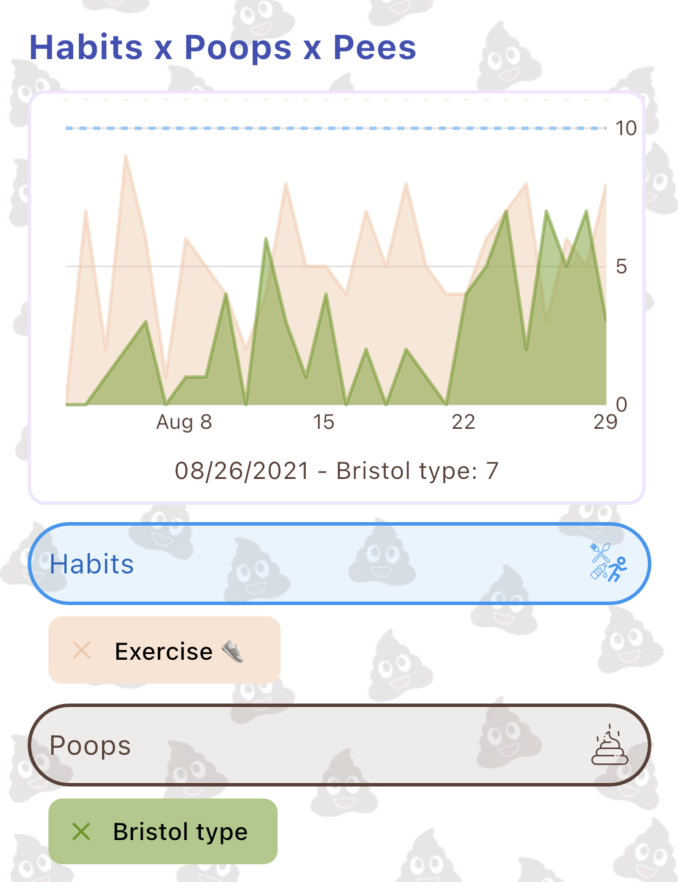
By logging consistently with standardized metrics like the Bristol Stool Scale, you build a personalized baseline. When sudden deviations appear—a shift toward Type 6 (mushy) stools or a drop in frequency—you have a record to reference. That lets you start connecting the dots immediately:
- Dietary Triggers: Did a specific meal or the introduction of a new supplement cause an inflammatory flare-up?
- The Stress Correlation: Did a high-anxiety week at work accelerate your colonic transit time?
- Hormonal Shifts: For women, overlaying digestive data with menstrual cycle tracking frequently reveals clear patterns of hormonal constipation or diarrhea during specific luteal or follicular phases.
Empowering Your Doctor Visits
One of the biggest challenges gastroenterologists face in practice is inaccurate patient history. When a problem arises and someone presents with "stomach pain and irregular bowels," the diagnosis process can be frustratingly slow. Memory is inherently biased, especially when you're in pain.
Imagine walking into a doctor's office not with vague complaints, but with a comprehensive data set. Being able to definitively say, "For the last 45 days, 60% of my stools have been a Bristol Type 6, usually occurring within one hour of consuming lactose, accompanied by level 4 abdominal cramping," completely changes the dynamic of the consultation. It allows your healthcare provider to bypass weeks of guesswork, accelerating the path to accurate diagnostic testing and effective treatment.

The Habit of Tracking: Minimizing Friction
The secret to successful long-term health tracking is consistency, and the secret to consistency is minimizing friction. Keeping a physical notebook in the bathroom is outdated, unhygienic, and easily forgotten. Modern digital tools have revolutionized this process. Utilizing an intuitive, privacy-focused application allows you to log comprehensive data—including Bristol type, color, and accompanying symptoms—in mere seconds, ensuring that your health history remains both accurate and secure.
Ready to Build Your Health Baseline?
Don't rely on memory for your medical history. Whether you use your smartphone or want the frictionless experience of smartwatch tracking, we've built the perfect tool for you.
Get started with Happy PoopShort-Term vs. Long-Term Tracking: Two Distinct Benefits
A lot of people expect gut health logging to pay off right away—when actually, it delivers two separate categories of benefit that work on very different time horizons. Understanding both helps set realistic expectations and keeps you motivated during the early weeks.
Short-Term Value: Acute Pattern Recognition
In the first two to four weeks of consistent tracking, you're mostly doing acute correlation work. By capturing meals, symptoms, stool characteristics, and stress levels in close sequence, you start spotting near-term triggers. If every entry logged in the 12 hours after a specific food comes with loose stools or bloating, that pattern becomes visible fast—even with a short dataset. This phase tends to feel motivating because the insights are actionable almost immediately: change something and see the effect within days.
Long-Term Value: Statistical Patterns and Trend Detection
The more powerful benefit—and the one that's clinically most significant—comes over months and years. Long-term data lets you detect gradual shifts that are completely invisible in the short term. A slow, sustained drift toward harder stools over six months, an increasing frequency of nighttime symptoms, or a creeping rise in abdominal pain scores that wouldn't alarm anyone in a single week can become unmistakably clear when you plot them over time.
This matters most for conditions that sneak up slowly. Early-stage colorectal changes, progressive lactose intolerance, post-viral gut dysmotility, and the gradual worsening of inflammatory bowel disease often look like barely perceptible week-to-week noise—but they crystallize into a recognizable pattern when viewed on a months-long timeline. Long-term trackers are statistically more likely to show up at medical consultations with data that enables an early diagnosis, which dramatically improves outcomes for conditions that respond best to early intervention.
Conditions Where Bowel Tracking Is Most Clinically Impactful
While any individual can benefit from the self-awareness that gut tracking provides, there are specific medical contexts in which structured, longitudinal bowel data transforms from useful to genuinely essential:
Irritable Bowel Syndrome (IBS)
IBS affects an estimated 10 to 15 percent of adults globally and is fundamentally a diagnosis of pattern recognition. There are no definitive blood tests or imaging studies for IBS—the diagnosis is clinical, built from symptom history and the exclusion of other conditions. That makes a comprehensive tracking log one of the most powerful tools a gastroenterologist has. The Rome IV diagnostic criteria for IBS require documentation of recurrent abdominal pain with a specific frequency and its relationship to defecation or stool changes. A patient who walks in with six months of Bristol Scale data, abdominal pain severity scores, and meal logs dramatically compresses the diagnostic timeline—and helps distinguish IBS-C (constipation-predominant), IBS-D (diarrhea-predominant), and IBS-M (mixed) subtypes, each of which has a different management strategy.
Inflammatory Bowel Disease (IBD)
Crohn's disease and ulcerative colitis are chronic inflammatory conditions that cycle between remission and flare. Tracking is critical for both monitoring disease activity and identifying flare triggers. The Harvey-Bradshaw Index for Crohn's and the Mayo Score for ulcerative colitis—clinical tools used to quantify disease severity—both rely heavily on patient-reported bowel frequency and symptom intensity. A patient who keeps a consistent record can catch the early signs of an emerging flare—a gradual uptick in stool frequency, a return of blood in the stool, or rising urgency—days before they'd otherwise seek emergency care, enabling earlier intervention and potentially preventing hospitalization.
Post-Surgical Recovery
After any abdominal surgery—appendectomies, cholecystectomies, bowel resections, bariatric procedures, or ostomy creation and reversal—bowel function restoration is the primary clinical recovery benchmark. Surgeons set specific targets for post-operative bowel function, and deviations from those expectations are early warning signs of complications: anastomotic leak, post-operative ileus (temporary bowel paralysis), or stricture formation. A structured digital record gives the surgical team an objective post-discharge log that's far more reliable than patient memory reconstructed at a two-week follow-up.
Elderly Care
For elderly individuals and their caregivers, bowel tracking serves a real quality-of-life and safety function. Constipation is the most common GI complaint in older adults, and its consequences go beyond discomfort: fecal impaction can cause overflow diarrhea, rectal bleeding, urinary retention, and increased fall risk. Many medications prescribed to older adults—opioids, antacids, antidepressants, calcium channel blockers—significantly affect gut motility. A medication change that impacts bowel function can go unnoticed for weeks without structured tracking. Caregivers use tracking logs to monitor output regularity, coordinate proactively with primary care physicians, and keep laxative use calibrated rather than reactive.
How Data Quality Improves Over Time
A health tracking dataset isn't like most digital tools—its value doesn't depreciate. The longer and more consistently you track, the more analytically powerful your dataset becomes. Gut health is governed by overlapping biological cycles—circadian rhythms, hormonal cycles (for menstruating individuals), immune fluctuation cycles, dietary patterns, and seasonal shifts—each operating on its own timescale and only becoming statistically visible once enough complete cycles have been captured.
One month of data is valuable for acute trigger identification. Three months allows cycle-level pattern recognition, particularly for hormonal correlations. Six months starts revealing seasonal patterns and longer-term lifestyle correlations. A year or more gives you the longitudinal profile that gastroenterologists most value for monitoring subtle disease progression or treatment efficacy.
Your data quality also improves as your logging habits sharpen. New users often start inconsistently—tracking some meals but not others, logging symptoms only when severe. Over weeks, logging becomes habitual, entries become more complete, and the data becomes more representative. Many people find that after 4–6 weeks, it stops feeling like a task and becomes a seamless part of their bathroom routine. That inflection point—from effortful to automatic—is when the dataset starts generating its most reliable insights.
Bowel Tracking and Colorectal Cancer Screening Context
Colorectal cancer is the third most commonly diagnosed cancer worldwide, yet it has among the highest survival rates when caught early. Routine colonoscopy is the gold standard for detection—but between screening intervals (typically every 5–10 years for average-risk individuals), the earliest warning signs most often show up as changes in bowel habits. That's exactly the data a consistent tracking log captures.
The American Cancer Society and major gastroenterology guidelines cite the following as symptoms that should prompt evaluation for colorectal causes:
- A persistent change in bowel habits lasting more than a few weeks—including new-onset diarrhea, constipation, or a change in stool caliber (narrow, "pencil-thin" stools).
- Rectal bleeding or blood in the stool, even intermittently.
- Persistent abdominal discomfort, cramping, or bloating with no clear dietary explanation.
- A feeling that the bowel does not fully empty (tenesmus).
- Unexplained fatigue or unintentional weight loss accompanying digestive changes.
Without a baseline, it's easy to rationalize these symptoms as stress or "something you ate." With a baseline, they stand out immediately and objectively as deviations from your established norm. A 90-day record showing a persistent, gradual shift toward narrow stools and increasing rectal urgency is a compelling, time-stamped reason to book a colonoscopy—regardless of whether you "feel sick." Consistent gut tracking functions as a bridge between scheduled screening intervals, providing continuous passive surveillance of your colorectal health.
How to Actually Start: A Practical Onboarding Guide
Knowing why bowel tracking matters and actually building a daily habit around it are two different things. The most common reason people abandon health logs isn't lack of motivation—it's poor implementation. These practical principles will help you build a habit that lasts:
1. Start Small, Not Comprehensive
When starting out, the instinct is to log everything: every meal, every drink, every symptom, every emotional state. That ambition is admirable but unsustainable. For the first two weeks, commit only to logging your bowel movements: type (Bristol Scale), frequency, and any accompanying pain or urgency. Nothing else. Once that core habit is automatic, you can layer in meal logging, hydration tracking, and symptom tagging. Adding too many variables at once creates friction and decision fatigue—and that breaks the habit.
2. Anchor the Habit to an Existing Behavior
Habit research—from Charles Duhigg and BJ Fogg in particular—shows that new behaviors are most successfully adopted when stacked onto existing automatic ones. For most people, using the bathroom is already a well-established daily routine. Reaching for your phone or smartwatch right after is a natural anchor point. Set up your app so a basic entry takes no more than 15–20 seconds. If opening the app feels like effort, the habit won't survive a busy morning.
3. Use Push Notifications Strategically
A single, well-timed daily reminder can significantly cut down on missed entries during the early habit-formation phase. Most adults have their primary bowel movement in the morning, making a mid-morning notification (around 9–10 AM) an effective prompt to log if you haven't already. Avoid too many notifications—that breeds resentment and automatic dismissal.
4. Review Your Data Weekly
Motivation to log consistently spikes when you can see the data building into meaningful patterns. Set a five-minute weekly review for yourself—Sunday evening works well—to scan your week's entries. Even recognizing that you logged 6 out of 7 days and can see a clear link between Friday's pizza and Saturday's bloating is enough to reinforce why the habit matters. The data should feel useful, not clinical.
5. Use the Wrist When the Phone Is Inconvenient
When pulling out your phone is genuinely inconvenient or socially awkward, a smartwatch companion app removes every remaining barrier. Happy Poop's wearable integration is built for exactly these high-friction moments: a quick tap on your wrist during a meeting, a commute, or any public setting keeps even the most inconvenient entries from getting skipped. Consistency matters more than perfection—logging 90% of events accurately is far more valuable than chasing 100% and quitting after a week.
Sources & Medical References: