Tracking Health on the Go: Why Smartwatches Matter
In the pursuit of better health, good intentions only get you so far. Any new wellness routine—especially something as detail-oriented as daily health tracking—lives or dies on one concept: friction. The less effort it takes, the more likely you'll stick with it.
The Psychology of Frictionless Habits
Here's a simple truth: if something feels like a chore, you'll eventually stop doing it. When logging your daily habits, hydration, and digestive health means finding your phone, unlocking it, digging through folders, and tapping through multiple screens just to record one data point—the habit won't survive a busy workday.
That's where wearable technology changes the game entirely. By moving the interface from your pocket to your wrist, smartwatches strip away the physical and psychological barriers to consistent data collection.
The Power of the Wearable Ecosystem
Today's smartwatch platforms—Apple's watchOS and Google's Wear OS—are a lot more than notification hubs. They're sophisticated health companions. With the right companion app, you can log detailed physiological data the exact moment something happens.
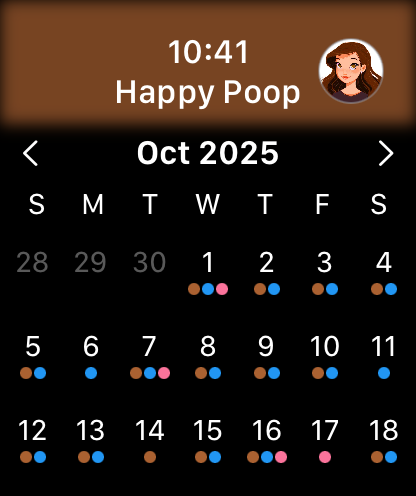
Whether you're selecting a Bristol Stool Scale rating, logging a glass of water, or noting a sudden onset of abdominal cramping, a well-designed smartwatch app lets you do it with two or three quick taps. That immediacy matters enormously for accuracy. You're not trying to reconstruct what happened hours later at the end of the day—the data is captured in real time, exactly as it happens.

Discretion and Privacy in Public Spaces
Let's be honest: digestive tracking is deeply personal. For people managing chronic conditions like Irritable Bowel Syndrome (IBS), Inflammatory Bowel Disease (IBD), or Celiac disease, symptoms don't politely wait until you're somewhere private—they happen in boardrooms, on trains, and at social events.
A smartwatch gives you an unmatched level of discretion. Logging an event from your wrist looks no different from checking a text or skipping a song. No need to pull out your phone in a public restroom or hide an app screen from coworkers. That combination of speed, accessibility, and privacy keeps your long-term data complete and uninterrupted—giving both you and your doctor the clearest picture possible of your health.
watchOS vs. Wear OS: A UX Comparison for Health Tracking
Not every smartwatch is built the same when it comes to health tracking. The two dominant platforms—Apple's watchOS (on Apple Watch) and Google's Wear OS (on Samsung, Google, Fossil, and others)—take meaningfully different approaches to the health interface. Understanding those differences helps you pick the right tool for your needs.
watchOS offers a tightly integrated ecosystem advantage. Because Apple controls both the hardware and the software, the health stack is seamless. The Apple Health app functions as a unified data repository, and third-party apps like Happy Poop can read from and write to it directly. The Digital Crown and compact Complications on the watch face make it easy to put a one-tap logging button front and center at any moment. Apple Watch also benefits from relatively consistent hardware across generations, so companion apps are built against a predictable screen size and sensor set.
Wear OS runs on a wider variety of hardware from different manufacturers. That diversity is great for cost-conscious users—entry-level Wear OS devices are significantly more affordable than Apple Watch—but it can introduce some variability in the app experience depending on screen resolution and device. The Tiles system in Wear OS (comparable to Apple's Complications) lets you set up a persistent logging shortcut accessible with a single swipe from the watch face, making it just as efficient for rapid data entry. Samsung's Galaxy Watch line in particular offers robust health sensors and a smooth companion app experience for Android users already in the Google ecosystem.
For digestive and symptom logging specifically, both platforms are highly capable. The decision mostly comes down to your phone: iPhone users benefit most from the tight Apple Watch integration, while Android users will find Wear OS devices offer a much more cohesive experience with fewer data-transfer headaches.
Privacy and Data Security with Wearable Health Data
Wearing a health monitor 24/7 raises a question that doesn't get asked enough: where does your intimate health data actually go, and who can see it? For digestive and symptom tracking—which can reveal information about chronic conditions, medications, and daily biological rhythms—this isn't a minor concern.
Both Apple and Google store health data on-device with encryption, but their cloud sync policies differ. Apple Health data synced to iCloud is encrypted end-to-end, meaning even Apple can't read it. That's a significant privacy advantage. Google Fit and Wear OS health data is also encrypted in transit and at rest, but Google's broader data usage policies involve more aggregated data sharing for service improvement.
For third-party health apps on either platform, the privacy picture is less uniform. Here are the key questions to ask when choosing a health logging app:
- Does the app transmit your data to its own servers, or does it process everything locally on your device?
- Is the app compliant with relevant health data regulations like HIPAA (United States) or GDPR (European Union)?
- Does the app's privacy policy explicitly state that your health data is never sold to or shared with third-party advertisers?
Happy Poop is built with a privacy-first architecture. Your personal logs are stored locally on your device and are never used for advertising profiling. When you're evaluating any health tracking tool, reading the privacy policy isn't optional—it's one of the most important steps you can take to protect your most sensitive personal information.
Real-World Scenarios: Who Benefits Most from Wrist-Based Tracking
The benefits of smartwatch tracking apply broadly, but certain groups experience a disproportionate improvement in their health management from this specific format.
The IBS Patient
For someone managing Irritable Bowel Syndrome, symptoms are unpredictable and can hit anywhere—a boardroom, a grocery store, a commute. The ability to discretely log urgency, cramping, and stool consistency the moment it happens, without retreating somewhere private with a phone, is genuinely transformative. Over weeks and months, that granular, real-time data helps pinpoint specific dietary triggers, stress correlations, and time-of-day patterns that are nearly impossible to reconstruct from memory alone. Many gastroenterologists now actively encourage their IBS patients to bring digital symptom logs to consultations rather than verbal summaries.
The Elderly Individual
Bowel function changes a lot with age. Slower colonic transit, reduced physical activity, polypharmacy (taking multiple medications simultaneously), and dietary changes all affect digestive regularity in older adults. Constipation is one of the most common and underreported complaints in elderly care, yet it carries serious consequences: fecal impaction, increased fall risk during straining, and medication side effects. A smartwatch-based logging system gives elderly individuals—and their caregivers—an accessible, low-barrier way to keep an accurate output record that can be shared with a primary care physician at regular check-ups, catching abnormal patterns before they become acute problems.
The Post-Surgery Recovery Patient
After abdominal surgeries like appendectomies, cholecystectomies (gallbladder removal), or bowel resections, the return of normal bowel function is a key clinical recovery milestone. Patients are typically asked to monitor and report their first post-surgical bowel movement, and ongoing tracking helps flag slow recovery patterns, obstruction risks, or complications from changes to gut flora and motility. A wrist-based logging tool keeps this monitoring effortless during a period when the patient is already physically compromised and juggling multiple recovery tasks.
Battery Life and the Long-Term Consistency Challenge
The single most significant practical challenge facing smartwatch health tracking is battery life. Long-term health data is only valuable if it's continuous. Even a two or three-day gap in a 90-day tracking record can muddy trend analysis—and if your watch died during a particularly symptomatic period, you've lost the very data that might hold the most diagnostic value.
Most modern smartwatches fall into one of two battery profiles: multi-day endurance (typically 5–14 days, common in Wear OS devices and Garmin/Polar sport watches) or daily charging (18–36 hours, typical of Apple Watch). Daily-charging watches require building a charging ritual into your routine—usually overnight or during a morning shower. Multi-day watches offer more flexibility but sometimes lack the richer health sensor suites of their daily-charge counterparts.
For health tracking, the best strategy is to choose a watch whose battery rhythm already fits your lifestyle—not one that forces a behavioral change. You want the device to disappear into your daily routine, collecting data passively while your deliberate log entries add context. A watch that dies every afternoon because you forgot to charge it creates exactly the kind of friction you're trying to eliminate.
Bringing Smartwatch Data to Your Doctor
A smartwatch health log only reaches its full potential when it bridges the gap between your daily experience and your clinical care team. Data that sits on your wrist alone doesn't accomplish much if it never reaches your doctor. Building a workflow to make that handoff effortless is the final—and most important—step.
Most health logging apps, including Happy Poop, let you generate summary reports or export your data in a readable format. Before a scheduled gastroenterologist, GP, or specialist appointment, take five minutes to review your recent entries and export a summary covering the relevant time period. Note any patterns worth highlighting: a sustained shift in Bristol Scale type, a new symptom that started on a specific date, or a recurring link between a specific food and an adverse reaction.
Physicians consistently report that patients who show up with structured, time-stamped data—rather than vague verbal summaries—get faster diagnoses and more targeted treatment plans. A quantified record eliminates the unreliability of retrospective memory (which studies show significantly underestimates symptom frequency) and replaces it with objective evidence. It also shifts the doctor-patient dynamic: you arrive as an informed partner in your own care, not just a passive reporter of vague discomfort.
In a broader sense, the smartwatch isn't just a convenience device—it's the missing link between the continuous, lived experience of your body and the snapshot that a quarterly clinical visit can ever hope to capture.
Sources & Medical References: