What is Meconium? Understanding a Newborn's First Milestone
The biological origins of the first mammalian feces and its critical importance in neonatal diagnostics.
The Origins of Meconium in the Womb
Meconium is the very first feces a mammalian infant—including humans—passes after birth. It's unlike anything produced later in life: instead of being made from digested food and gut bacteria, meconium forms entirely during the baby's time in the womb.
Throughout pregnancy, a fetus practices breathing movements and continuously swallows the surrounding amniotic fluid. That fluid isn't clear—it's a suspension of cellular debris shed by the developing baby. Over the course of the pregnancy, the fetus swallows lanugo (the fine, downy hair covering their body), mucus, bile, water, and desquamated epithelial (skin and intestinal) cells. Because the fetal gastrointestinal tract is sterile and lacks the microbiome adults have, this ingested material doesn't ferment or putrefy.
Instead, all of it slowly accumulates and concentrates in the baby's intestines, forming a viscous, sticky, tar-like substance. By the time a full-term infant is ready to be born, their entire large bowel is packed with this thick, dark greenish-black, and almost entirely odorless material.
The Postpartum Transition
Passing meconium is a key medical milestone—it tells clinicians that the newborn's gastrointestinal tract is structurally complete and working properly. In a healthy scenario, an infant will pass their first meconium stool within the first 12 to 24 hours of life.
Getting this sticky substance moving is helped along by the mother's first milk. That very first milk produced after birth is called colostrum. Beyond being packed with antibodies and nutrients, colostrum acts as a natural, gentle laxative—it stimulates the baby's digestive tract and helps push the viscous meconium out of the bowel.
The Color Progression
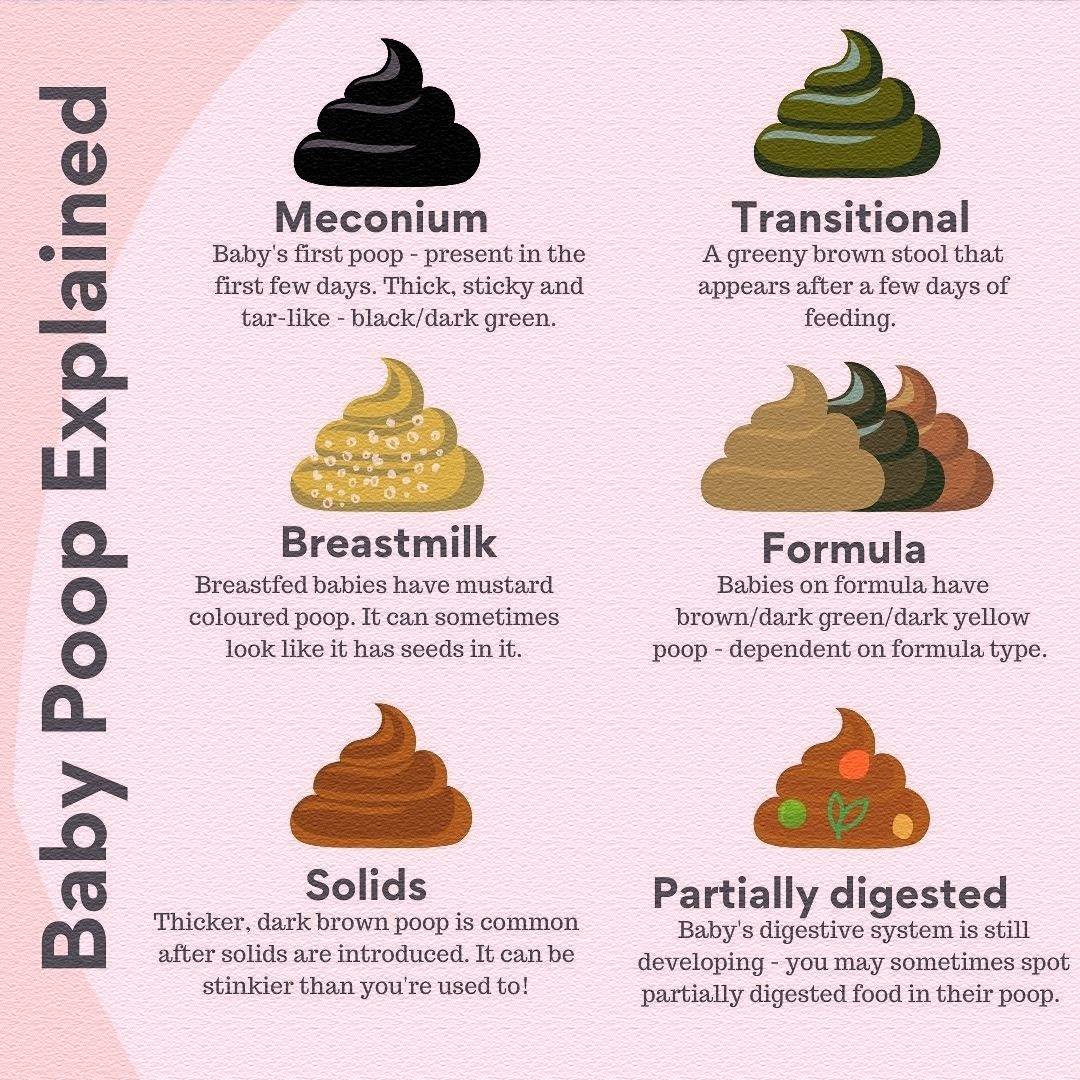
Over the first three to five days, parents will notice a rapid and distinct evolution in the color and consistency of their baby's stool, moving from meconium to "transitional stool," and finally to mature milk stool:
- Days 1-2: Thick, tarry, dark greenish-black (Pure Meconium).
- Days 3-4: The stool becomes less sticky, shifting to a lighter greenish-brown or khaki color as the meconium mixes with digested milk (Transitional Stool).
- Days 5+: The stool becomes loose, seedy, and mustard-yellow (the standard appearance of breastfed infant stool) or slightly firmer and tan (if formula-fed).
Clinical Warning Signs: Failure to Pass
Pediatricians watch closely until the first meconium is passed. If a full-term newborn hasn't passed any meconium within the first 24 to 48 hours, it's an immediate clinical red flag—a signal that there may be an intestinal obstruction or anatomical defect.
Conditions associated with a delayed or absent passage of meconium include:
- Hirschsprung's Disease: A congenital condition where critical nerve cells (ganglion cells) are missing from the muscles of a portion of the baby's colon, preventing the bowel from relaxing and passing stool.
- Meconium Plug Syndrome: Occurs when the meconium is exceptionally thick and forms a physical, hardened plug that blocks the colon, sometimes requiring an enema to dislodge.
- Anorectal Malformations: Structural or anatomical defects where the anus or rectum did not develop properly during gestation.
- Cystic Fibrosis: Approximately 20% of infants born with Cystic Fibrosis present with Meconium Ileus, a severe obstruction where the meconium is so thick and sticky it entirely blocks the terminal ileum (part of the small intestine).
When a delay does occur, neonatal doctors will typically use radiologic studies—abdominal X-rays or contrast enemas—to quickly diagnose the location and nature of the obstruction.
Why Meconium Composition Matters Clinically
Meconium's job doesn't stop at confirming the gut works. Its composition is increasingly recognized as a valuable window into fetal development and what the baby was exposed to in the womb. Because meconium accumulates continuously throughout the second and third trimesters, it functions like a biological archive—a long-term record of everything the developing fetus encountered.
Researchers analyze meconium samples to detect substances that crossed the placental barrier during pregnancy—including nicotine metabolites, heavy metals, and certain medications. Unlike cord blood analysis, which only captures a snapshot in time, meconium-based biomarker analysis can reflect exposures spanning the entire second half of gestation. This has significant implications for understanding fetal development and early intervention.
The meconium microbiome—once assumed to be completely sterile—has become an active research topic. Studies suggest the fetal gut may not be entirely free of microbial colonization before birth; small numbers of bacteria may transfer from the mother via the placenta or amniotic fluid. The bacterial composition detected in meconium may offer early clues about an infant's immune development and long-term allergy or autoimmune risk. It's an evolving area of science, but it makes clear that the first diaper is far more interesting than it looks.
Meconium Aspiration Syndrome (MAS)
One of the most serious complications linked to meconium is Meconium Aspiration Syndrome (MAS)—a potentially life-threatening condition that occurs when a newborn inhales a mixture of meconium and amniotic fluid into the lungs around the time of delivery.
Under normal circumstances, a healthy fetus doesn't pass meconium until after birth. But when a fetus experiences significant fetal distress—most commonly from oxygen deprivation (hypoxia) or umbilical cord compression—the anal sphincter can relax, releasing meconium into the amniotic fluid before delivery. In that same stress response, gasping respiratory movements can draw the contaminated fluid into the lungs.
Meconium-stained amniotic fluid (MSAF) is found in roughly 10 to 15 percent of all deliveries, though MAS develops in only a fraction of those cases. When it does occur, the inhaled meconium sets off a cascade of problems:
- Mechanical obstruction: Thick meconium particles can partially or completely block small airways, trapping air and causing uneven lung inflation (known as "air trapping").
- Chemical pneumonitis: The bile acids and digestive enzymes within meconium are directly toxic to delicate lung tissue, causing severe inflammation.
- Surfactant inactivation: Meconium disrupts pulmonary surfactant, the critical substance that keeps the small air sacs (alveoli) of the lungs open. Without surfactant, the lungs partially collapse with each breath.
- Secondary infection: Meconium creates a growth medium that increases the risk of bacterial pneumonia in the neonatal period.
Treatment for MAS depends on severity and ranges from supplemental oxygen and CPAP to mechanical ventilation and, in the most critical cases, extracorporeal membrane oxygenation (ECMO). Obstetric teams trained to spot meconium-stained amniotic fluid during labor are ready to intervene immediately at delivery to minimize aspiration risk.
Day-by-Day: The Full Transitional Stool Timeline
The shift from meconium to mature newborn stool follows a predictable biological schedule, though individual timing can vary based on feeding method, feeding frequency, and gut motility. Here's what's clinically typical for a healthy, full-term newborn:
Days 1–2: Pure Meconium
The stool is the characteristic thick, tarry, dark greenish-black meconium. The texture is similar to motor oil or thick molasses, and it's notoriously hard to clean off skin. It has virtually no odor because the sterile fetal gut produced no fermentation. Most healthy newborns pass their first meconium stool within 12 hours of birth; nearly all do so within 24 hours. Passing meconium is one of the first clinical milestones the nursing team documents.
Days 2–3: Early Transitional Stool
As the newborn starts feeding—colostrum via breastfeeding or formula—the gut has its first encounters with externally ingested material. The stool takes on a greenish-brown color and becomes a bit less sticky. This phase signals that the GI system has begun clearing the meconium and that feeding is doing its intended job via colostrum or formula stimulation.
Days 3–5: Late Transitional Stool
The stool continues to lighten, shifting from greenish-brown to a yellow-green or khaki color. Consistency also changes—it gets looser and less paste-like as the concentration of ingested milk rises relative to residual meconium. Frequency starts to climb as the gut adapts to its new, externally fueled role.
Day 5 Onward: Mature Milk Stool
By the end of the first week, the stool should fully reflect the infant's feeding method, and the timeline differs noticeably between breastfed and formula-fed infants (see section below). At this stage, any stool that remains dark, tarry, or black—resembling early meconium—is abnormal and needs immediate pediatric evaluation, as it may indicate delayed transit, feeding insufficiency, or an early sign of gastrointestinal bleeding.
Breastfed vs. Formula-Fed: How the Transition Differs
One thing that genuinely surprises many new parents is how dramatically different a breastfed newborn's stool looks compared to a formula-fed infant's. Both are normal within their respective contexts—knowing the difference prevents a lot of unnecessary anxiety and unnecessary medical calls.
Breastfed Infant Stool
Once mature milk stool establishes (around day 5–7), breastfed infant stool is typically:
- Color: Mustard yellow, sometimes with a bright or golden yellow tone. Occasionally green or slightly orange—all normal.
- Consistency: Loose, runny, and often described as having a "seedy" or "cottage cheese" texture, with small curds visible. This is the partially digested casein protein from breast milk and is completely normal.
- Odor: Surprisingly mild and somewhat sweet, reflecting the primarily lactose-based diet and the composition of the breast milk microbiome.
- Frequency: Highly variable. Newborns may stool after every feed (6–10 times daily) in the early weeks. After 4–6 weeks, some exclusively breastfed infants begin stooling much less frequently—sometimes only once every several days—which is still normal as long as the stool remains soft and the infant is thriving.
Formula-Fed Infant Stool
Formula-fed infant stool has a distinctly different profile:
- Color: Tan, yellowish-brown, or pale yellow. Slightly more "earth-toned" than breastfed stool.
- Consistency: Firmer and more paste-like than breastfed stool, often compared to smooth peanut butter. The higher protein and iron content of formula contributes to this denser texture.
- Odor: More noticeably pungent than breastfed stool, reflecting a different fermentation profile in the gut.
- Frequency: Typically more regular and predictable than breastfed stool: usually 1–3 times per day in the early weeks, though this can vary.
Parents who switch from breastfeeding to formula, or introduce a formula supplement, will notice a relatively quick shift in stool characteristics—sometimes within 24 to 48 hours. Similarly, introducing solid foods around 6 months will again dramatically change the stool's color, odor, and consistency.
When to Call Your Pediatrician: Stool Warning Signs in the First Month
The normal range of newborn stool appearance is wider than most people expect. That said, there are specific characteristics and circumstances that call for prompt medical evaluation. Contact your pediatrician immediately if you notice any of the following:
- No meconium passed within 48 hours of birth in a full-term newborn (hospitals monitor this, but awareness is important if a rapid discharge occurs).
- Persistent black, tarry stool beyond Day 3–4 in an infant who is actively feeding, as this may indicate inadequate milk intake and failure to clear meconium, or in rare cases, upper gastrointestinal bleeding.
- Red or maroon-colored stool at any point, which may indicate lower GI bleeding. Note: red food dyes in formulas and certain maternal dietary choices (beets, red food coloring) can occasionally cause reddish discoloration, but blood should always be ruled out.
- White, pale gray, or chalky stool, known as acholic stool. This is the absence of bile pigment and is a serious warning sign for biliary atresia—a rare but serious liver and bile duct condition that requires urgent surgical intervention in the neonatal period.
- Mucus in the stool combined with blood, which may indicate a milk protein allergy or infection.
- Explosive, watery, and very frequent stool with a change in feeding behavior or signs of dehydration (sunken fontanelle, fewer than 4–6 wet diapers per day, dry mouth, lethargy) may indicate newborn gastroenteritis, which can be serious in the first weeks of life.
- Consistently very hard, pellet-like stool with visible straining and distress, especially in a formula-fed infant, warrants evaluation for formula tolerance and constipation.
Why Tracking Newborn Output Matters in the First Weeks
Every healthcare provider will tell new parents to monitor and log their newborn's wet and dirty diapers in the first weeks of life—and it's not an arbitrary suggestion. Newborn diaper output is one of the most direct and reliable indicators of whether a baby is getting enough nutrition. This is especially critical during the establishment of breastfeeding, when milk volume isn't visibly quantifiable.
The American Academy of Pediatrics (AAP) and lactation consultants outline expected diaper counts by day as a feeding adequacy proxy:
- Days 1–2: 1–2 wet diapers and at least 1 meconium stool per day.
- Days 3–4: 3–4 wet diapers and at least 1–2 transitional stools per day.
- Days 5+: 6 or more wet diapers and at least 3–4 stools per day (breastfed) as feeding fully establishes.
Falling below these thresholds—particularly fewer than 6 wet diapers per day after Day 5—is a clinical signal that the infant may not be getting enough milk and is at risk for dehydration and newborn weight loss beyond the acceptable 7–10% of birth weight.
A daily diaper log also gives the pediatrician essential context at each well-baby visit. Stool frequency, color changes, consistency shifts, and any episodes of visible straining or blood are details that are nearly impossible to recall accurately under the sleep-deprived haze of new parenthood. A digital tracking record lifts that memory burden, ensures accuracy, and gives your doctor a complete picture of the infant's gastrointestinal development from day one. That's exactly the kind of use case where apps like Happy Poop—and parental tracking tools in general—deliver genuine, clinically meaningful value in the early weeks of a child's life.
Sources & Medical References:
- American Academy of Pediatrics (AAP) - Newborn Health and Stool Guidelines.
- Wikipedia - Clinical definitions of Meconium and Fetal Development.
- NIH / StatPearls - Meconium Aspiration Syndrome: Clinical Review.
- NIH / PubMed - Biliary Atresia and the Clinical Significance of Acholic (Pale) Stool in Neonates.